The bread and butter hi-fi product is the affordable bookshelf speaker…
Friendly to budget, it doesn’t ask too much of one’s hard-earned cash.
Appropriate for smaller spaces, it’s ideal for a broader range of homes.
And yet, the bookshelf speaker can provide exceptional music listening experiences far beyond what you get from soundbars, all-in-one home speakers and portables.
Arguably, the only thing missing is that extra bottom end. But that can be had later on by adding a subwoofer.
So, perhaps nothing in the stereo shop is as appealing as the bookshelf speaker.
How does one choose a pair of bookshelf speakers?
By listening to them.
That’s the only thing that can tell you how your music will sound through them. And the best approach is to listen to more than one model, so you can see what’s possible and make a relative judgement.
Granted, if for any reason at all you cannot listen, the only replacement is to hear from someone else who has.
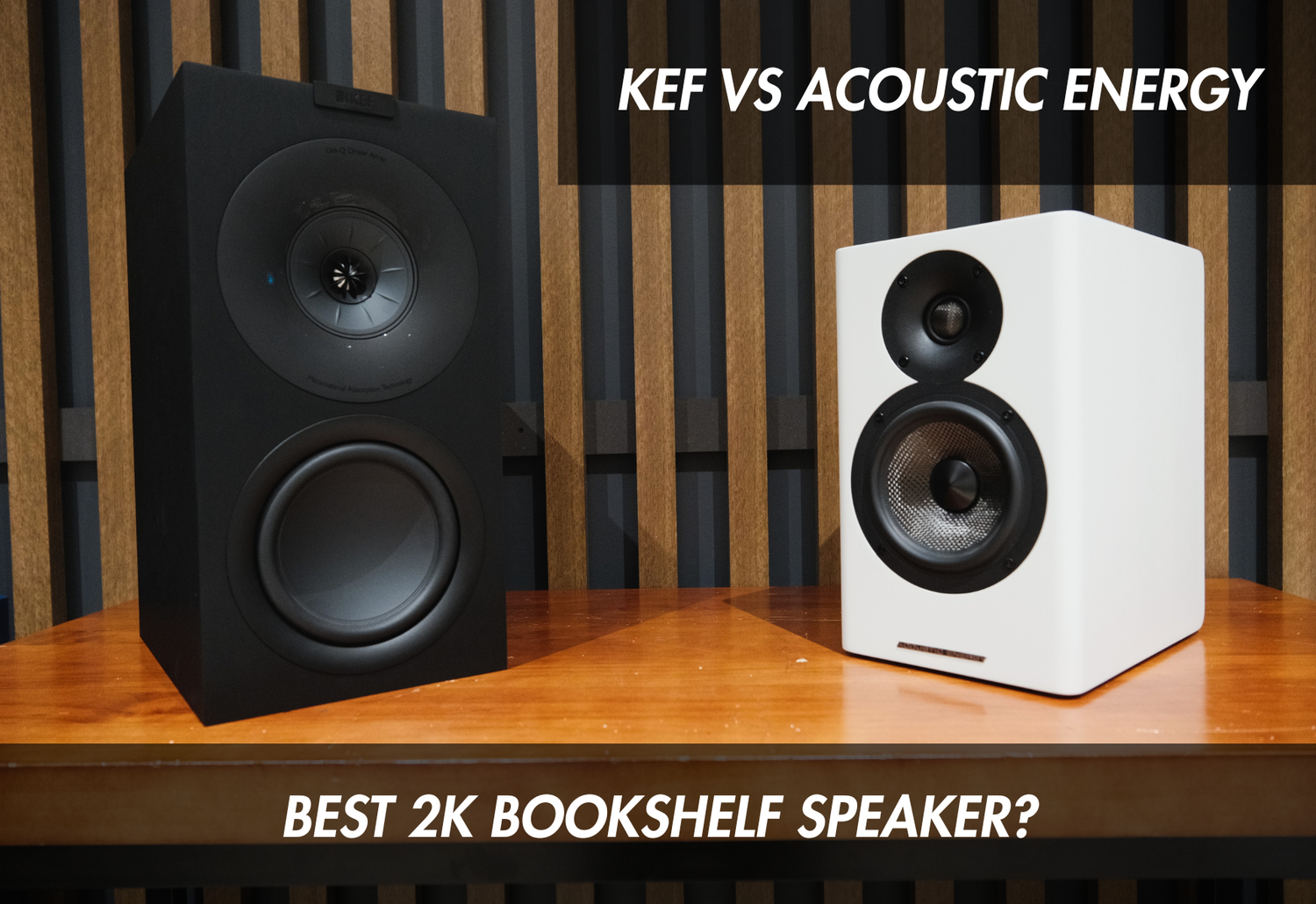
That’s why today I want to share my experience with two of the top contenders for best affordable bookshelf speaker: the KEF Q Concerto Meta and the Acoustic Energy AE500.
Both come in at around $2,000 Australian. After years of selling hi-fi on the showroom floor, I’ve found that this price level ushers in a significant sound improvement compared to lower levels.

The KEF Q Concerto Meta hit the scene near the end of 2024.
It’s a tribute to the 1969 KEF Concerto; a speaker that was known for delivering deep bass despite being a quarter of the size of every other home speaker at the time.
Thus, the Q Concerto is designed to have an unusually strong bottom end from a budget-sensitive bookshelf speaker.
The AE500 on the other hand have been around for awhile longer, however it’s worth noting that Acoustic Energy are known for taking years to develop new products. They’re meticulous and insist that if a new model should come out, it should be much better than the previous.
It sports a high-density cabinet material that’s rarely found in affordable speakers, and that allows for more cabinet space—thus, more bass from a smaller speaker. Considering it’s noticeably smaller than the Q Concerto, this feature is probably crucial to make it competitive.
It also features custom-made carbon fibre drivers which promise a dynamic and accurate sound, given how carbon fibre is highly rigid and responsive.
As for my audition, here are some setup notes:
- Streaming Tidal CD-quality to the Bluesound Node Icon
- AudioQuest RCA interconnects to the ARCAM A15 integrated amp
- AudioQuest Rocket 11 cables to either set of speakers
- Both speakers were placed on KEF’s SQ1 stands
- I listened to three songs from different styles of music.
Enough preamble. Let’s get into the listening notes:
First up, Red Rain by Peter Gabriel.
I started things off with a style of music that I consider balanced and ideal for testing audio gear.
Billed as “art rock,” I think of artists like Peter Gabriel as a nice blend of rock with the production quality and catchiness of pop. This style of music always shows detail, imaging, treble response, and gives a sense of both warmth and clarity. It can sometimes demonstrate bass response.
If I had to pick one song to judge a system, it would probably be from Peter Gabriel or, for similar reasons, David Bowie.
I went with Gabriel’s Red Rain this time.

Starting with the KEF Q Concerto Meta, I immediately noticed how big the sound was. It felt like the music was filling the room and wrapping all around me. The soundstage was very wide. Edges were soft, which came through nice—easy to listen to. Percussion sounds and vocals sounded fairly accurate and dynamic.
Switching to the Acoustic Energy AE500, with the deep guitar (or synth?) hits in the beginning, the word “meaty” jumped out at me. The sound was really rich, but clear. Much more focused and centred, definitely not filling the room quite as much. In general there was less of the “ambient” feeling (where the sound gives off a sense that you’re in an acoustic space).
Separation—which is when different sounds coming from the same place in the soundstage are very distinct—that was noticeably better with the AE500. Percussion and vocals were clearer.
Worth noting, the AE500 were more placement sensitive and needed a little toe in to create a proper image. I didn’t have to toe the Q Concerto in at all; they were perpendicular to the back wall, firing directly into the room.
Okay, next song.
When the Levee Breaks from Led Zeppelin is a classic.
It’s fun to listen to, and gives any listening sesh a bit more zest. Test-wise it’s a great way to see how a system handles busier, more chaotic music without losing the quality recording aspect.

I kept the AE500 hooked up from the last test. Immediately the track was lively, clear and dynamic. Most of the body of the guitar and percussion came through with great detail. Vocals were front and centre. Imaging was awesome.
If I focused on any one part of the soundscape it became nuanced and textured. Especially the “analog distortion” sound of the vocals mid-track.
However I did have an immediate sense that the sound could’ve been bigger. The song presents like a live performance—a big live performance. I suspected that could’ve been more prominent.
Switching to the Q Concerto Meta and that ambient “bigness” was in full swing.
Bigger. Fuller. Room filling. It truly sounded like a stadium concert—at the cost of separation and detail, but for this song that felt right. Like a welcoming pair of shoes worn a thousand times.
That analog distortion effect was even better this way. It almost had this clipping sound, which again, sounded too right. (Clipping is when audio equipment is driven at such a high volume that the sound waves are cut off at the tops. It’s almost always unwanted distortion, however it can be used artistically, like in this song.)
All up for this one the KEF speakers kept enough detail, but played along with the feeling of the song that they really stood out. The Acoustic Energy sounded good but as a matter of comparison, their presentation was less “on theme.”
Next song…
Ghostman, an eccentric electro-industrial piece from the Canadian band Skinny Puppy.
I’ve been using this song a lot lately to test low-end performance, because I know how powerful the bass drop at 57 seconds should feel. It’s also a good test of imaging and dynamics, filled with samples and effects.

I kept the Q Concerto Metas hooked up.
Within a few seconds I had a sense that maybe the sound effects were coming through less detailed than they should’ve. The bass thumps were huge though. Rich and thick.
When the drop came at 57 seconds, it hit alright, but it felt like it should’ve been deeper and tighter.
As layers were added into the mix things felt a bit mashed together. Some effects seemed drowned out. That said the overall presentation was exciting and fun. It was dancey as hell. And in fact, dance music does sound awesome on the Q Concertos.
After putting the AE500s back on, everything was cleaner. The sound effects were clear and separate. It was more apparent what effects were intentionally distorted.
In general the song came through more balanced. When the drop came the bass extension seemed the same as with the KEFs, but it was tighter. This gave it more of the powerful feeling I was looking for.
The sound was punchy, and that was awesome. The AE500s were bringing this one to life a bit more. The only downside that came to mind was that they could be fatiguing to some.
So, that was the final song in my test. Which speakers were better?
Well, if you can’t tell from the listening notes, there isn’t really a “best” option. Which is why reviews like this are so useful.
The better choice for you is the one that suits your listening preferences. Not necessarily genre…but what styles of music do you want your system to excel at, and what qualities of a given song matter the most to you?
- Both the Acoustic Energy AE500 and the KEF Q Concerto Meta had decent and similar bass extension.
- The AE500 had noticeably better overall fidelity and realism, but the Q Concerto was still solid in that regard.
- The AE500 presented clear with more separation between distinct sounds, and had a tighter bass response.
- The Q Concertos gave a big, room-filling sound and wide soundstage that felt more like a live concert.
This is such an important dichotomy. Neither clean and clear nor big and room filling are “best.” Neither does a particular style of music better. It really comes down to the listener.
Both of these speakers can play any style of music and give a wonderful performance. But each has strengths, so depending on how you enjoy your music, you’d probably extract more excitement from one of these versus the other.
If you’re considering them and cannot make it to a showroom that has both on display, here’s an approach you might try:
Take some time to listen to some of your favorite music with whatever you have now. Pay attention to what qualities and parts of the music give you the most feels. And reference these listening notes to see which speaker likely provides more of what you love.
Happy listening!