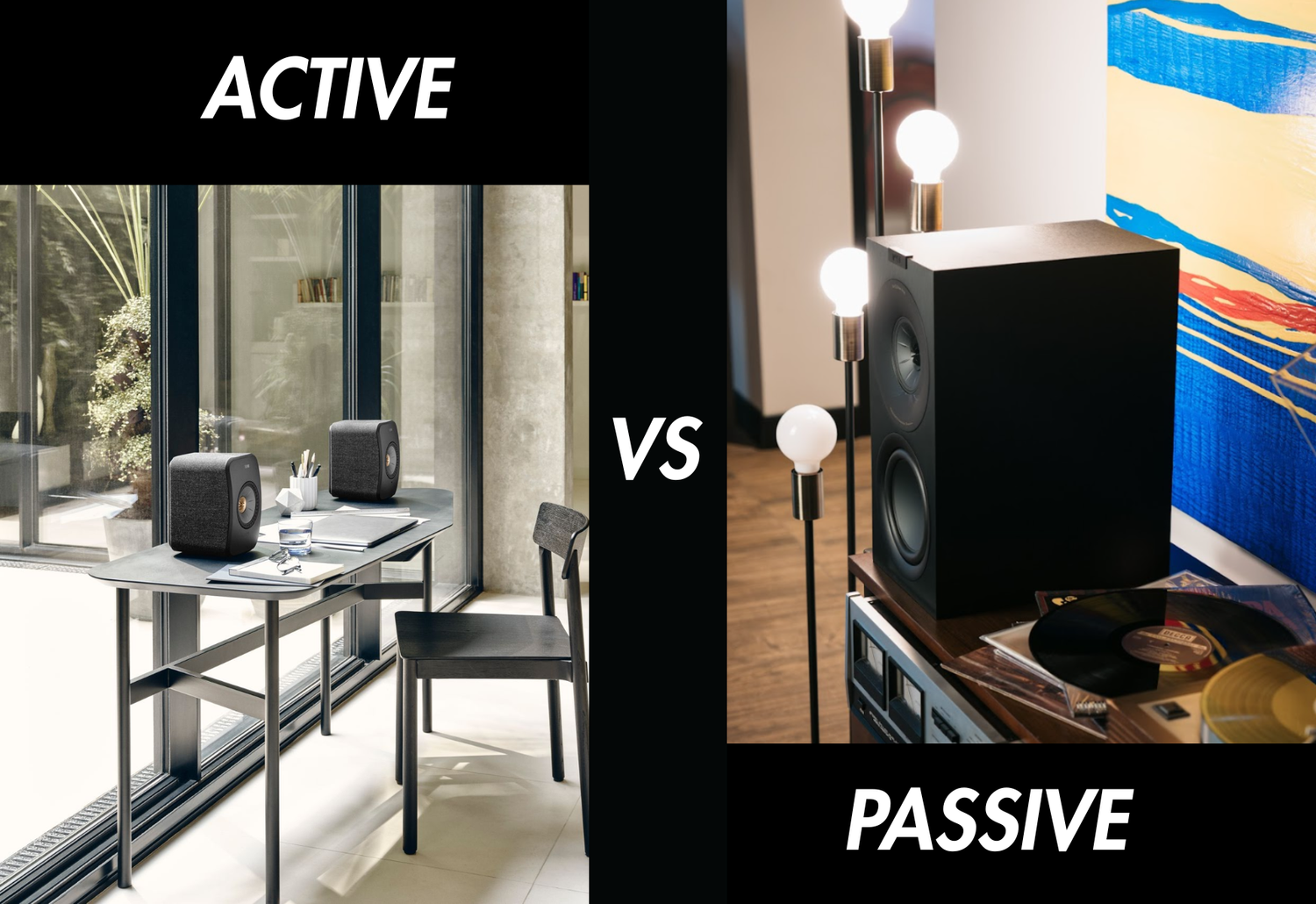
What's the difference between active and passive speakers?
The short answer is active speakers have amps inside and passive speakers require external ones...
...however the nuances are important, because there are advantages and disadvantages to each.
So let’s break it down. Below you’ll discover:
- What are active and passive speakers?
- Should you go active or passive?
- Powered speakers vs active speakers
- Active vs passive speakers: technical differences
What are active and passive speakers?

Passive speakers are a traditional stereo component.
They require either an integrated amplifier or a power amplifier to drive them, and don’t need to be plugged into a wall socket.
They consist of a cabinet with speaker drivers and a passive crossover network—which is a circuit board that filters different frequencies and sends them to the appropriate drivers.

Active speakers are defined as having an internal, dedicated power amp for each driver and handling the crossover process before amplification.
They may or may not have DAC or streaming functions built in. They may or may not handle volume control, input switching and crossover filtering digitally. They may or may not require a power cable on both speakers.
Those features don’t affect the definition. So if you’re already decided on active speakers, you’ll need to think about which one has the features you want.
However, when considering whether to go active or passive, the thought process is different.
Should you go active or passive?
Active and passive speakers each have their own engineering advantages and disadvantages. One doesn’t necessarily sound better than the other.
It more accurately comes down to flexibility and potential.
If you get the KEF LS50 Wireless II, you get internal amps that are tuned for their speaker design—where the passive LS50 Meta give you the option to pair with any amplifier, of any quality level.
Ultimately, when it comes to sound quality, you’re looking for an audio system that plays the music you love in a way that gives you the most emotional experience.
The styles of music you enjoy, the aspects of sound that make the biggest impact on you, those things vary from person to person. So the best approach to finding your ideal-sounding speaker is to demo and hear a few different options, and see what connects with you the most.
That could involve either active or passive speakers.
However, of course, the system must also meet your needs for features, inputs, size, aesthetics and other logistics.
It’s up to you to prioritise among sound quality and logistics. But make sure whatever you get, it has the input connections you need and whatever features you want—like Wi-Fi streaming, Bluetooth, TV compatibility, phono preamp for a turntable, and so on.

Here are a few questions you can ask to help you decide between active or passive speakers:
- Do you have room for electronics? Can you fit a streaming integrated amp or separate units, and run cables to the speakers? If not, active is better for you, particularly if the speakers have streaming built-in.
- Do you like the idea of upgrading or tweaking your system later on when you have more funds? If so, passive lets you do that.
- Do you like exploring and choosing the various components of your system? If so, passive lets you do that.
- Do you want tower speakers? (If you want the best performance and have a big room, towers are the better choice.) If so, passive gives you more options.
- Are you going for a particular look? If so, passive gives you more options.
- Do you want a truly incredible high-performance system? If so, again, passive gives you more options.
Powered speakers vs active speakers
These two terms get thrown around a lot, however powered speakers are not necessarily active speakers.
Powered speakers are simply speakers with amplifiers built-in.
How that’s implemented is irrelevant. Most powered speakers are essentially passive speakers with small integrated amplifiers inside one of the cabinets. That one is called the “master” and the other is the “slave,” where the master has a power cable and then there’s a cable between the two. These handle the crossover filtering after the power amp stage just like passive speakers do.
Active speakers are a subset of powered speakers. They tend to sound much better than powered speakers of similar quality, because their design is optimised for performance.

Active vs passive speakers: the technical details
Refresher: Passive speakers contain a crossover network and speaker drivers, and require an external amp to power them. Active speakers contain power amps for each driver, and a crossover process that comes before the power amp stage.
By having less inside, passives avoid issues related to "crosstalk." Electric currents flowing within a component cause electromagnetic interference, which can affect the output signal.
So a design with more components in one enclosure is vulnerable to this source of noise and distortion. It also requires more components to be running off the same power supply inside the speaker—another source of noise.
However, actives often use amps that are optimised for the very speakers they power. A given amp has one driver and frequency band to focus on, making it’s job easier and by extension, freeing the amp up to perform better relative to its specs.

The active approach also opens the door to more processing in the digital domain. Volume control, equaliser functions, room-correction DSP, input switching—all these things can be done digitally, avoiding the costly challenges of doing them in analog, such as with a traditional preamplifier.
Another such advantage is in the crossover process I mentioned above.
Here’s why crossovers are different in active and passive speakers…
In a passive speaker, the crossover network is a circuit board inside the cabinet. It receives a powered audio signal from an external amp, and then filters and divides it into different frequency bands, and passes them to the appropriate drivers.
For example, a crossover will isolate bass frequencies and pass them to the speaker’s woofer. If it tried to send the full frequency range to the woofer, the high frequencies would sound poor or completely missing because the woofer struggles to vibrate at higher frequencies (due to its size and material properties). This would likely also cause the bass sound to suffer, because the woofer would be trying to do too much.
In an active speaker the crossover does the same thing…except that it occurs before the power amp stage. That means a much lower voltage signal is being processed.
This allows the job to done not by capacitors and inductors suited for high currents, but op-amp circuits and delicate components that can achieve more precise results where frequency bands overlap.
Plus, filtering before the amp stage avoids the speaker drivers’ varying impedance, which affects crossover performance. Instead the power amp input impedances are fixed and well-defined.
At this point it might sound like active speakers are easily the better choice…
But “better” for a lot of people will come down to the actual sound—not theoretical performance advantages. And again, passive speakers provide flexibility and engineering liberty.
If you go passive you have access to a wider range of options.
In terms of sheer quality, there are hands down better speaker and electronics pairings available.
High-end audio engineering teams focus on making one individual component perform to as high a standard as possible…instead of finding ways to fit a lot of components in one enclosure. Combining a few of these top-tier dedicated components is audibly on a whole other level.

Conclusion…
Hopefully you found this enlightening.
If you want to see some examples of great active speakers, check out these:
And for examples of great passive speakers, try these:
Happy listening!