There’s a salient difference between an audio product made to fit a market, a price point, a sales target, versus one made by passionate engineers, intent solely on producing absolute quality.
For those who have the means, and choose not to compromise, the latter is where the deepest satisfaction lives.
And the most important place to enlist such passionate help might just be at the source.
An audio system’s source is crucial…
It’s the furthest point from music hitting your ears. Errors and distortion at the source are not just carried forward, but amplified multiple times by the rest of the system before the speakers play them.
So if there’s one component that needs to be precise, it’s the source... and the most versatile audio source is the network streamer.
There are great improvements in stepping up from common streamers like those from WiiM, Eversolo or Auralic, to the creations of more dedicated makers like Innuos, Linn or dCS.
It’s like renewed prescription lenses: all aspects of the music are more refined, clear, textured, and lifelike. All because the electronics handling the most sensitive part of the signal chain are more precise, and better at correcting for noise.
Innuos take to engineering hi-fi like da Vinci took to the canvas…
That is, by making it an expression of passion, knowledge and skill, and by focusing every ounce of attention on creating something of extreme quality.
Innuos were founded by Nuno Vitorino, a computer science engineer, who began developing a music streamer for his own use in 2009. After seeing it excite his friends, he decided to improve on the design by controlling more of the process himself.
Since 2018, the company has made their own software, electronics and chassis components at their lab in Portugal, outsourcing very little of what goes into their products—despite the increased costs of that approach.
Quality matters to these fanatics. They make almost everything themselves, to painstaking standards, and it shows in both user experience and listener experience.

Innuos' mid-tier STREAM3 is as versatile as a Swiss Army knife, and as precise as a Swiss watch.
It can be configured to act as a network streamer, DAC, music server, CD ripper, Roon Core, or all of them combined—and it can do all of those jobs to an extremely high standard.
For instance, as a music server...
The STREAM3 can store and catalog 2, 4 or 8TB of music. So you can own your music library, support the artists you love, and free yourself from the “you will own nothing and like it” subscription model takeover.
Add an optical CD drive and you can rip high-res files at the touch of a button, converting your collection into a convenient music library, while the streamer plays unaffected.
Further, for those who own a dCS DAC, standalone Innuos servers like the STREAM3 play along seamlessly. Such pairings are very common in high-end systems, with Innuos and dCS officially collaborating on software integrations.

As a network streamer...
The STREAM3 gives you a high-quality USB output and several optional output modules.
These modules include two DAC performance tiers, an SPDIF output board, an I2S board for third-party DAC integration, and an even better USB output with greater isolation and a 5V line regenerator.
The STREAM3 owes its exceptional performance, in large part, to its power supply and digital clocking systems.
Power supplies take alternating current from the wall, adjust the voltage, and attempt to convert it into DC with filtering capacitors. This results in an imperfect, “bumpy” voltage signal.
Quality audio power supplies then add a feedback loop (called a regulator) to correct for much of the remaining high-current noise in the DC signal. They’ll then output the signal to the next device… however, low-current noise (or “hum”) still passes through the regulator.
Innuos insist on the lowest possible noise. So, in collaboration with renowned British power supply designer Dr. Sean Jacobs, the Innuos STREAM3 adds another noise-rejection stage—the “CX module”—which eliminates that low-current hum. This makes for a significant performance improvement in sensitive streaming hardware (like clocks, SSDs or output stages).
Further, the STREAM3 power supply feeds additional, separate regulation stages for each subsection (like the USB output stage, SSD, CPU and so on).
That means each subsection essentially has it’s own regulated power supply rather than sharing a common rail—providing clean power to each, and protecting the sensitive output stage from interference.
On the clocking front, consider that quartz clocks vary in frequency as temperature changes.
This is fine in battery-powered watches which don’t generate much heat—but in audio applications, this won’t do. Digital information must arrive at the conversion stage in consistent intervals for the DAC to perform properly.
Innuos have thus used oven-controlled quartz clocks (OCXO oscillators) in the STREAM3.
These clocks hold the clock frequency to a staggering measure of accuracy. Even then, however, the clocks leave room for improvement in consistentcy.
This is a common issue with quartz clocks: the accuracy is measured across a broad sample of time, which doesn’t account for consistency in the short-term. (It only tells us that errors are cancelled out over the measurement period.)
Innuos have resolved this consistency issue by adding a second clocking stage to the PhoenixDAC module: dual transistor-based FemtoClocks refine the quartz signal for incredibly precise edge-arrival timing.
Between these power and clocking systems, the result is an enormous uptick in performance by the time the signal reaches the speakers.
Now let’s see how it fared in an actual listening experience.
Innuos STREAM3 Review
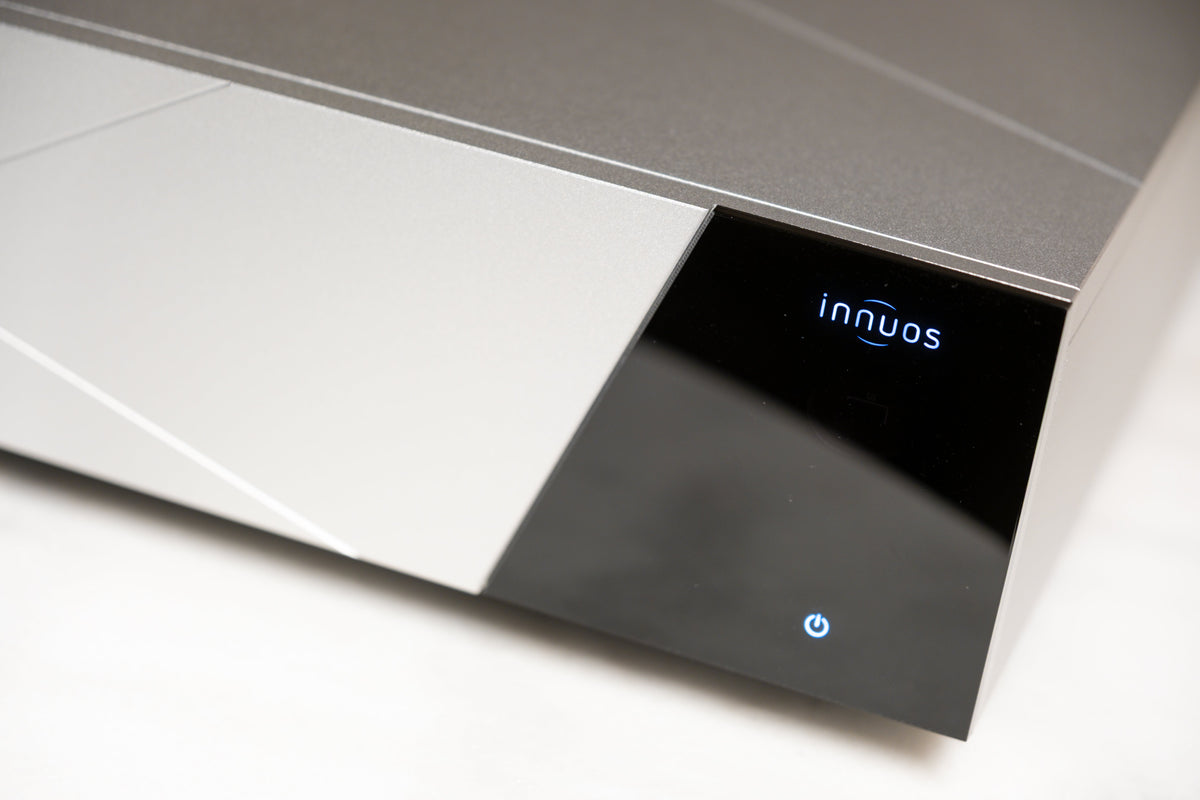
A substantial 10mm of aluminium gives excellent acoustic and electrical isolation. A bead-blasted and anodised finish gives that serious build-quality look and feel. A subtle, chameleon LED indicator glows in colour, tastefully indicating system state.
The Innuos STREAM3 is a beautiful piece.

You’ll forget all about that however, when you go to use it, because Innuos’ in-house Sense app will steal your attention. Frankly, it's the best music control app I’ve used to date.
It’s very rare for an app to tick all the boxes:
- Stylish yet clean presentation.
- User-friendly interface (where you can easily find what you’re looking for, no matter what it is).
- Well thought out queue-building functions (especially the “insert track next in queue” feature, which I don't take for granted).
- Immaculate response times (no lag) and, for the duration of my time with it, no bugs or drop outs (not even when using the integrated Qobuz streaming service).
It’s clear that the fact that they develop their software in-house is a big deal. They’ve done really well here.

Again, this particular STREAM3 is fitted with the Phoenix DAC, their best performing option with an additional digital clocking layer.
Instead of trying to make an absolute judgement, I split test the STREAM3 with an Arcam ST25 we had in the showroom.
The Arcam ST25 is a good contender, as it sports its own engineering solutions for power supply noise and DAC error reduction.
Either streamer acted as a DAC and was plugged into a substantial analogue ensemble: a Dan D’Agostino Progression preamp and Progression S350 stereo power amp, into a pair of Marten Parker Trio floorstanders, all tethered with Nordost cables.
I listened to part of an instrumental jazz album I love: Matthew Halsall’s Ai (Bonus Track), off of Colour Yes.
Through the ST25 it sounded brilliant. Despite a few minutes rest for my ears while changing to the STREAM3, the first note of the song caught my attention. I heard a noticeable increase in attack for the sound of the cello, and more of the instrument’s timbre (the unique resonance of the body, or cabinet).
The snare drums were noticeably more separate. And some notes of the trumpet had a distinct echo that just wasn’t there when I switched back to the ST25.
Next I put on Ten Years Gone by Led Zeppelin. Again, with the ST25 the presentation was stunning. The soundstage was wide and instruments were well-placed across the scene. Depth and dynamics were excellent.
Switching to the STREAM3 and, as good as it sounded before, some improvement was immediately apparent. The word timbre still jumped out at me; the texture of the guitar, it had more bite to it.
Both of these setups took me back to being 21. They sparked a memory of listening to the same song around a fire, deep in the woods of Maryland, while celebrating life with good company.
But only one gave me a sense of awe; a sense that the system in front of me was a great feat of bespoke engineering and craftsmanship.
Make no mistake: both systems sounded damn good. However the STREAM3 brought the music to life. It was a palatable and sensual difference. Something best described as realism.
What Innuos have done here is quite special.
While they have even more precise equipment in their flagship register, the STREAM3 makes some of their best work more accessible (the STREAM1 does even moreso).
User experience is second to none, and audio performance is incredible—which means a lot here because, as discussed, the source makes the biggest impact when it's precise and free from noise.
If you’d like to experience the Innuos STREAM3 yourself, we’d love to have you in our showroom. Our dedicated listening rooms are acoustically treated and our espresso machine is kept warm. Reach out here to let us know you’re coming and we’ll have a system ready when you arrive.
Happy listening!