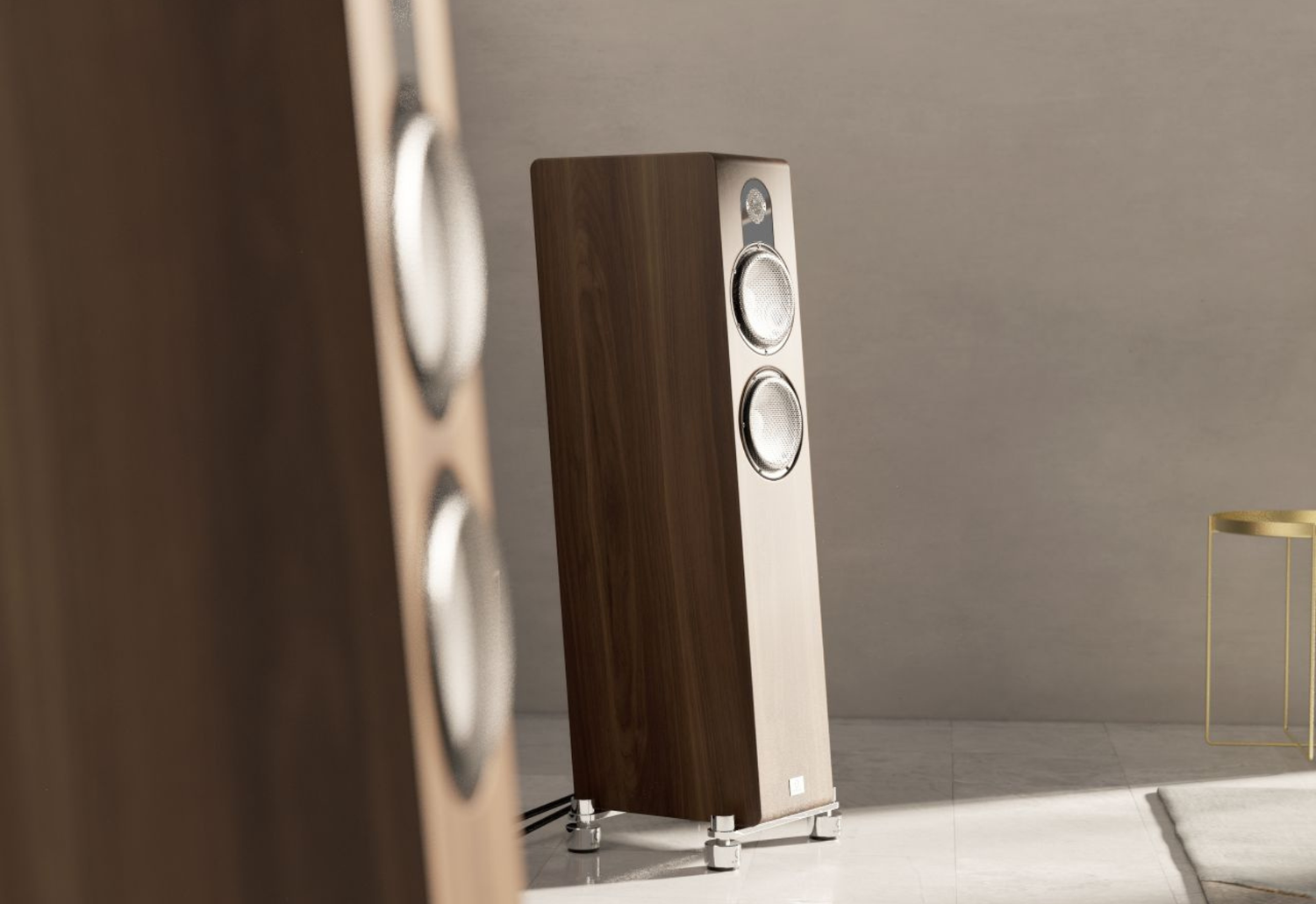
Swedish loudspeaker company, Marten, hand-build what may be the most visceral-sounding speakers on Earth.
With regard to fidelity they sound real — so real, they’re easily among the finest high-end audio creations — yet somehow they also capture the way live music wraps our hearts in rich emotion to an extreme degree.
And they’re born of human hands, human ears, and human minds.
Their unique performance has less to do with the overwhelming might of digital technology, and more to do with brilliant execution of the fundamentals: material choices, handmade first-order crossovers, clever solutions to common problems… and an approach to performance refinement that computers cannot yet replicate.
Today I want to share who Marten are, and how they do it.
Once upon a time there lived a young Swedish man with music in his blood…
One of his grandfathers made violins based on the world-famous Italian Stradivarius string instruments. His other grandfather played those violins.
Two musical families came together to bring this young man into the world. As a teenager, while studying to become an electronics engineer, he began building speakers in the family garage.
Music was in his blood.
His name was Leif Mårten Olofsson.
Leif developed his hobby year after year, growing ever-wiser about the construction and materials needed for excellent music reproduction. Roughly 20 years after he began his journey, welling with insight, he discovered the unique, ceramic drivers created by German brand Accuton.
These drivers were coated with a thin layer of aluminum oxide, making them incredibly lightweight and rigid.

Drivers that don’t flex, don’t distort. This made for a serious innovation in audio reproduction… and Leif knew they had tremendous potential.
With these new ceramic drivers, Leif built the original Mingus loudspeaker, his first commercial release. Then shortly after in 1998 he founded his company Marten, in Gothenburg, Sweden.
Five years later Marten released the Coltrane series — introducing diamond tweeters and carbon fibre cabinets — which put them on the map.
That didn’t change Leif’s ethos.
Every product maker on Earth could learn something from Marten.
They’re a premium, handmade manufacturer, and a family-run business (with Leif’s two brothers heavily involved). They have custom parts and materials made just for their products. They obsess over their material choices. They apply just as much art to their process as they do science.
And there’s more.
They focus on going further with fewer products. That means they invest heavily at the frontier of their range and prioritise creating real improvements in audible performance, rather than looking to “fill holes in the market.”
And they don’t release a new product unless they’ve made a genuine improvement to the current model — so their end users can trust that every new product is an upgrade.
They also spare no expense when developing their higher-tier models, so they can push the envelope on performance quality. The resulting technology “drips down” to their more affordable options, giving more listeners a chance to enjoy their sound.
In dedication to music, first and foremost, Marten have grown to include a recording studio and record label in their company.

This is the “secret sauce” to their performance refinement. Leif and his team listen to live music in the very same room that they test and tweak the sound of their speakers — giving them a true benchmark for how music really sounds.
On that note, every model spends ample time in that room being refined by ear.
Of course the process begins by getting the measurements to where they need to be… but it’s then fine tuned by ear, to achieve what are small differences in the measurements, yet big differences to the performance.
Marten also insist on using handmade, first-order crossovers in their speakers rather than factory-built, circuit board variants.
This is actually quite special. (What follows is a brief explanation to illustrate why; feel free to skip to the next section if you prefer.)
Speaker crossovers rely on capacitors and inductors to filter the audio signal by frequency. First-order crossovers involve passing the audio signal through one layer of these components. Second order crossovers involve two layers, third involves three, and so on.
Each time a signal is filtered by a layer (either a capacitor or inductor) the frequencies that are left have a gradual “roll off” of 6 dB per octave. This means the transition from one driver to another is relatively gradual. It requires both drivers to handle wide frequency bands, and they must be carefully implemented, and of excellent quality.
Filter the signal through another layer and that roll off becomes steeper and more defined, at 12 dB per octave. Do it again and you’ve got 18 dB. These sharper transitions make the job of any given driver easier, reducing quality demands and making it easier to coordinate all the drivers involved.
That’s why second and third order crossovers are used in most speakers available today.
The thing is, capacitors and inductors don’t just pass energy through — they store and release it. So each time a signal is filtered by a layer, it is also shifted in time. Thus with second and third order crossovers, the sound coming from each driver is out of time by a small amount, which can smear the sound of drum hits and other transients.
That’s why Leif insists on using first order crossovers, even when implementation is more complicated. And the extraordinarily stiff Accuton drivers he uses helps this process.

Not only that, but Marten have developed something else that supports their use of first order crossovers.
One of the most fascinating innovations Marten have developed is a natural material crossover.
Of course, every worthwhile speaker driver is made from materials to suit its rated frequency response. However Marten have really pushed the envelope on this.
Using the Coltrane Quintets as an example, they have a diamond tweeter, beryllium upper midrange, carbon fibre lower midrange, and two aluminium woofers each.
Why so many materials? Marten have worked out that these selections are ideal for the frequency bands they’re employed for. This they say, makes them extremely cohesive and makes each speaker sound “as one unit.”
So the very materials they’ve chosen act as natural crossovers, making each driver especially suited to its job. This plays well with the gradual transitions between drivers that comes with first order crossovers.
All up, these efforts make for a remarkable sound.
When I first encountered the Marten sound in one of our listening rooms (with the Coltrane Quintets), I found it surprisingly unique…

In high-end audio this seems crazy to me; different speaker series usually have small variations in timbre, with everything having excellent fidelity. This was, in all seriousness, something else entirely.
To my ears it was the epitome of warmth and richness, yet it was revealing and detailed… which is almost an oxymoron, as warmth usually smooths over fine details and acts as a trade-off. But I’ll be damned if the Quintets didn’t have both.
This unique sound is a stunning result of Marten’s artistic intent.
It’s the result of boldly using first order crossovers. Of refining designs by ear in the same room real music is heard. Of hand constructing everything in-house.
Dr. Bose famously said that stereo speakers should sound more like a live show than a cold recording studio. Of course, Bose the company shifted from high fidelity audio to making lifestyle products to suit the modern world. But if Dr. Bose had a chance to hear what Marten have accomplished before he passed on, I imagine his heart would’ve welled with appreciation. And his eyes, with tears.
Today, we’re proud to announce that Audio Connection have brought the Marten loudspeaker range onto our catalogue.
That includes their most esoteric high-end creations as well as their most accessible offerings.
The range begins with the Oscar Duo bookshelf speakers, which come in at $10k AUD per pair. Despite their size and the fact that they’re Marten’s entry-level model, they offer the same rich sound. Hence why independent reviewers love them, like Terry Ellis who raved about their “full-bodied sound” and how they “easily do room-filling bass like you’d expect from a much bigger speaker.”

A handful of models are ready for audition in our showroom right now, and other models can be arranged on request.
If you’re interested in being wrapped in a rich, emotional sound unlike anything you’ve ever heard, reach out to us today and let us know which ones you’d like to hear.
We’ll have them ready for you when you arrive.