When foraging for that special pair of speakers to bring home, you want to make sure you’re getting the best flavour profile for you…
It sounds like a worthy adventure at first. And then you realise there are many options to browse, just a few clicks away. Dozens of brands, even more models, and they’re all different, with many qualities to consider. Bass response, detail and clarity, “wow factor.” Will it play your music in a way that you enjoy? All these concerns and more.
Suddenly shopping for a pair of speakers worthy of your investment seems a cumbersome, subjective affair.
But what if you could bypass all the nebulous, wishy-washy guesswork of judging a speaker and get right to the point: is this speaker good or not?
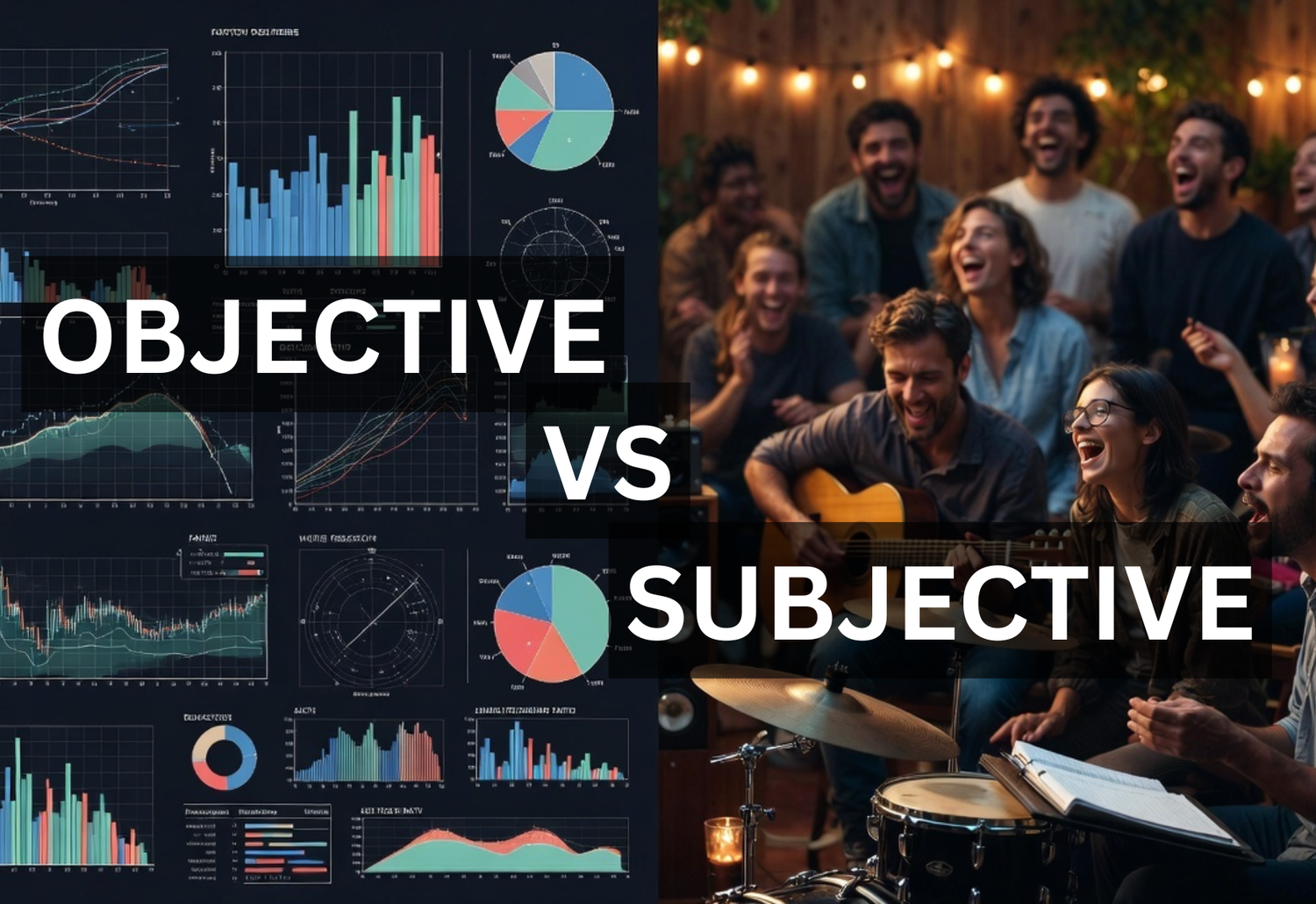
Many believe you can. Enter the objective study of acoustic measurements.
If you must discern the quality of a speaker before you buy, why not use the same methods as the engineers who make them?
The imperfections of your ears, the acoustics of a room, heck, even your mood…all factors that muddy your ability to judge performance. If you use a microphone instead, and conduct standardised measurements of a speaker’s performance, you can then rely on objective information to make your decision.
Ah…certainty.
Objective study of a speaker’s performance metrics can be an excellent tool. How does it work? Well, as an example, consider the most bare-bones approach.
Speaker frequency response explained
This is a graph that essentially shows how loudly a speaker represents each frequency of sound.
A microphone is placed in front of the speaker and a sine sweep is played through it—which sounds like a slide going from low sub-bass up to a high-pitched squeal. It covers the entire human hearing spectrum of 20 Hz to 20,000 Hz. Each frequency occurs at the same amplitude, so ideally the speaker will produce each frequency at the same volume (called “sound pressure level” or SPL).
If the measurement is taken in an anechoic chamber (a room that’s 100% acoustically treated to eliminate all reflections) the ideal frequency response will be a perfectly flat line. Every frequency played will produce the same SPL. It’s worth noting that, if you were to listen to a system in an anechoic space, you’d feel sick pretty quickly. There’s nothing natural about it.

If it’s taken in a real room—one that’s untreated or normally treated—then the ideal result will be a straight line that starts slightly higher in the bass registers, and declines consistently through to the treble registers.

Example of a frequency response curve; credit to Erin's Audio Corner
This is because in any real space, bass waves travel around the room and reflect off of surfaces, causing them to stack and amplify. This skews the response to be higher towards the lower frequencies, which is actually preferably to any listener.
The ever talked-about “flat” frequency response is not really what you want. If you were to artificially force a speaker to give a flat response in-room, it would sound thin, shrill, fatiguing, and stripped of all bass.
Regardless of whether your frequency response curve is taken from an anechoic chamber or in a real room, it’s utility is the same. You look for peaks or dips of the curve away from the “ideal” line, and reflect on how they would correlate with the speaker’s sound. For instance, a wide dip through the upper-mid range (say 2–4 kHz) might make a speaker sound more laid back and “warm.”
Then, after analysing the frequency response, you’d look at a radiation plot. This shows how widely each frequency disperses as it radiates from the speaker.
The radiation plot can help to inform how a speaker might sound in a room. Bass always disperses in every direction, and then as you move into higher frequencies the radiation pattern narrows. But how that narrowing occurs can vary. For instance, if you have a mid range that’s unusually wide, any sounds in that band may interact with the room and provide a sense of a wider soundstage.
The radiation plot can also be used to spot issues with crossovers—where say, the mid range driver tapers off and the tweeter picks up—which can cause sudden changes to the sound dispersion. This can artificially alter the soundstage, or produce tonal mismatch.
Of course this is just the basic approach. There are other measurements and specs one might consider to judge a speaker. There are also more sophisticated methods of analysis.
If one were to use them all, they could paint quite a vivid picture of how a speaker performs.
So, is the objective path the best way to judge a speaker’s sound signature?
Well… it’s not without caveats.
For instance, consider that a frequency response curve is a plot of only two pieces of information: loudness (y-axis) and frequency (x-axis). This means the plot strings together data points that represent the loudness of the speaker while it played a single frequency.
Trouble is, a given frequency is defined by how many sine wave peaks there are per second. So the curve says nothing about attack and decay performance, and it doesn’t show stored energy or resonance effects — in other words nothing in the time domain. This is especially noticeable in the bass, where two speakers can measure flat but one has tight, accurate bass and the other is boomy or “slow.”

This can be overcome by looking at additional measurements. But there are more caveats.
Consider that the frequency response curves are taken from non-music playback. While a snapshot of musical playback can indeed be defined as a composite of individual frequencies, the driver is made of physical materials with properties that can vary depending on loading conditions (or how “flexed” they are). In essence, a speaker’s job is easier when it’s playing one frequency at a time, versus a dynamic ensemble of instruments and voices.
If you’ve ever listened to a cheap, boomy subwoofer where you can’t distinguish between two different bass guitar notes, you know that frequency and loudness are not the only factors that matter to sound signature.
Then there’s “psychoacoustics.”
Consider that what the hearing system interprets and what is actually present are not the same thing.
If you look into how hearing works, you learn that this becomes more pronounced as you move up the frequency range.
So even a fairly significant-looking dip in the frequency response curve can be subtle or even inaudible, if it’s fairly thin and in the higher registers. For example in one of his videos, Amir from Audio Science Review described a big dip in the 1–2 kHz range of a particular speaker, which he then corrected with a big +4dB boost. Despite the huge change, he found the difference in actual listening was “very subtle.”
Plus, a person’s emotional relationship to different sounds isn’t universal. For instance, someone who gets a buzz from big bass might prefer a speaker with an artificial bass boost.
You must also ask if you prefer the feeling of a live show or a quiet studio…
In real contexts, acoustic reflections and ambient noise are present. This makes for a bigger, more room-filling sound with softer edges. It’s impossible to hear tiny details in such an environment. Compare that to the immaculately treated studio where all you hear is the music, with a “black background” that reveals everything. They’re not the same thing, yet they’re both valid.

One final caveat worth mentioning is that objective studies are fairly good at judging a speaker in isolation…but they have to work very hard to help us predict performance in context of many other factors. Factors like the amplifier you’re using or the media source (such as vinyl).
Using amplifiers as an example: Going from one amp to another can widen a soundstage, tighten a bass response, and smooth out sibilants…which really confounds any effort to judge a speaker objectively without hearing it.
So, objectivity may not be quite as it seems.
The objectivist looks at a series of measurements and says, “This is all I need, I know how it sounds.” The subjectivist listens to it and says, “That experience was wonderful…”
In full transparency, I’m working my way back around to describing the virtues and use-cases of objective measurements. Who they’re great for, what they’re great for.
But first we should consider the subjective approach: actually listening to a speaker and judging its performance based on the experience.
If there are factors affecting sound quality that are not easily seen in its measurements, then it’s possible to judge a speaker based on those measurements and actually be wrong about whether you’ll enjoy it.
Thus, “getting to the point” may be more synonymous with going and listening to the speaker you want. Even better if you bring your existing source and amplifier with you, so you can hear the speaker in your system—or ask to hear a few different amps in the showroom too, if you’re starting from scratch.
A good showroom is worth more than a demonstration.
Not only can you listen to products in a showroom, but you can discuss what you’re looking for with a consultant—who, if they’re good, will give you a lot of insight without pushing anything onto you.
You’ll also have the chance to explore other options—not just speakers, but amplifiers and other components—even options you weren’t aware of.
That said, unfortunately some showrooms have staff that aren’t genuine. They may be trying to sell you something instead of helping you find the right solution. Subjectivity can be used to push customers towards upsells and add-ons and the like.
But that won’t happen in a good showroom: the staff will be facilitating your personal journey. They’ll encourage you to try things and form your own opinions. They might suggest looking for certain qualities in what you hear, but they won’t project absolute judgements onto you.
Something worth adding here: the showroom is not your room (of course). So the system you listen to there will sound different at home to some degree. The thing about this is, however, that your room will have the same effect no matter what you bring home. If it affects the sound enough to spoil your experience, then the room needs to be addressed. You don’t really want to look for a hi-fi system that’s colored to compensate for your room, as that would mean the system itself isn’t to your liking. So it’s better to treat the room and tweak speaker placement instead.
In short, don’t worry about whether your room sounds different to the showroom. Focus on the gear.
So, now that we’ve heard from the objective and subjective sides of the coin, what shall we make of it? As is often the case, the answer is to realize that both are valid and useful.
If you enjoy measurements and right angles—perhaps you’re an engineer type, or an “objective perfectionist”—then by all means use them, and have fun with the process.
But I recommend keeping it in context of the real outcome you’re after: the auditory experience. That’s why the key to making measurements work is first learning to interpret them…and then calibrating your understanding to match the actual sound.
In other words you must understand a speaker’s plots, then listen to that speaker thoroughly to correlate those plots with its sound…and then do it again with another speaker, and another, and repeat until you’re calibrated.
Only then can you really estimate how a speaker will sound by looking at its data. Sound time consuming? It is. That’s why it’s really best for those who enjoy the process.
Now with all of that said…
Measurements are also useful if you simply cannot listen to a speaker because there are no showrooms around you.
Studying objective measurements and reading five or so reviews can then improve your odds on a blind online purchase. Plus, objective measurements can be a reason to feel curious about exploring a particular speaker.
And finally, there is one surefire use case for objective measurements: and that’s to disqualify crappy speakers. If you look at an anechoic frequency response curve and it has hideous 5+ dB swings up or down, you might take it out of the running. Of course, this is rarely the case with products made by reputable, long-standing brands. So it may not be that important depending on what you’re looking at.
There is ultimately a subjective experience bestowed by each music system, which cannot be measured precisely.
To wrap this up, consider the following.
When people describe the bliss they experience while listening to favored music through a great system, they don’t talk about peaks and dips. They talk about a singer’s voice, an echo, a sense of being in a concert hall, the euphoria they feel, and other experiential, human artifacts.
Getting lost in the technical details is to drift from what makes hi-fi valuable. It’s to transition from enjoying music into enjoying technical analysis. Nothing wrong with that. But just ask yourself…
…what is it that you’re looking for?