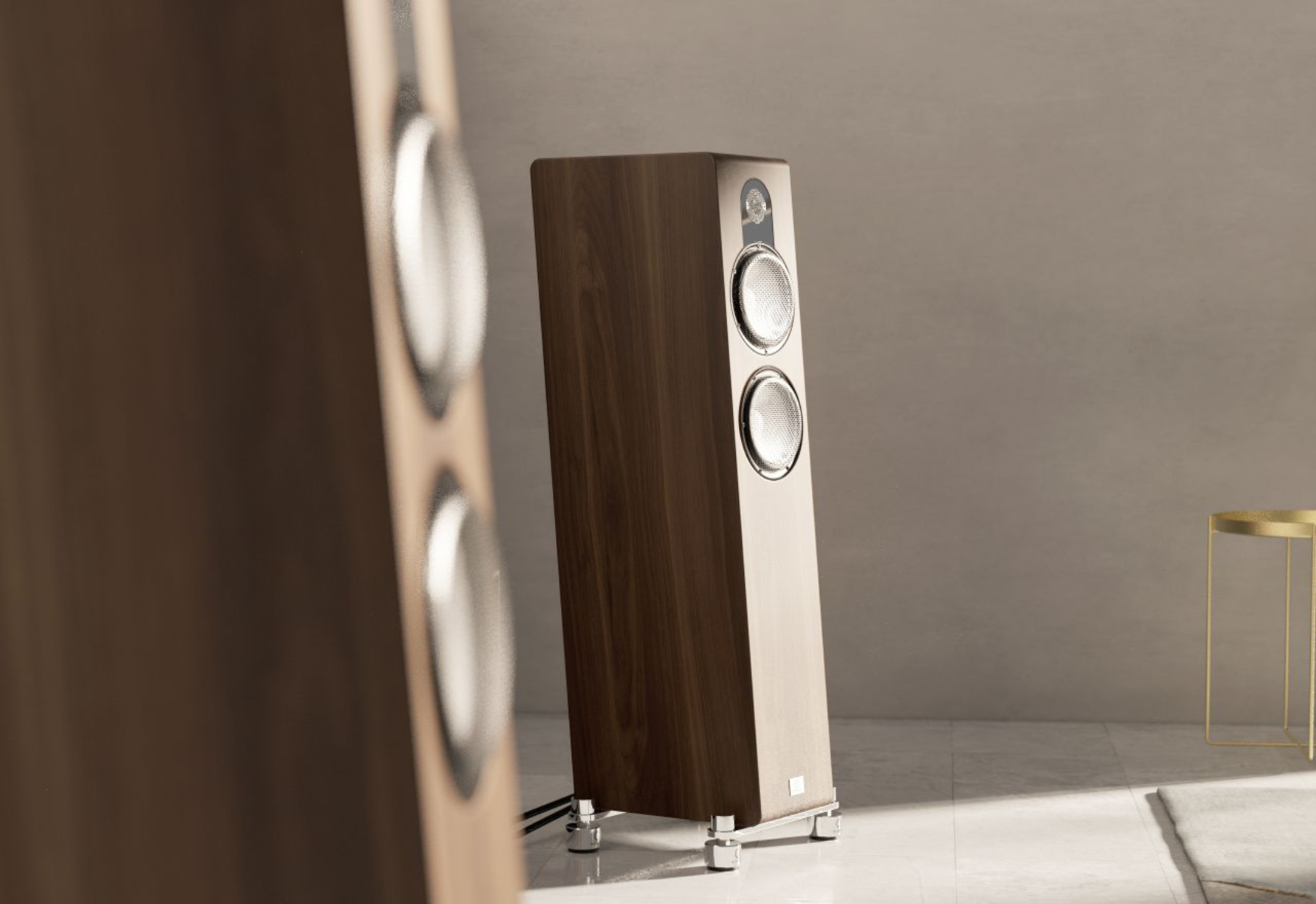
Bookshelf speakers are a brilliant choice if you want an amazing sound. They’re more compact and easier to manage than floorstanders, but still give you a rich performance with stereo separation.
If that’s what you’re after, this guide will run you through a list of great bookshelf speakers currently available, and you’ll learn what to look for and how to choose along the way.
Here’s what’s in store:
- What to look for in bookshelf speakers
- How to shop for bookshelf speakers that suit YOU
- How to shop for bookshelf speakers online
- Active vs passive speakers (and other FAQs)
- 8 of the best bookshelf speakers in 2026
What to look for in bookshelf speakers
The first thing you’ll want to do when browsing your options is focus on reputable loudspeaker brands. This is a general rule of course, but it’s excellent advice for those who don’t already know what to look for.
“Reputable” means the company’s focus is on creating audio products that sound as good as possible… as opposed to audio products that are intended to appeal to as many people as possible. (That doesn't mean all their products are esoteric and expensive; hence why the key word is primary.)
You can usually tell this by looking at their product lines.
A reputable brand will usually have some traditional passive speakers (not just powered speakers). They’ll also have some higher-end products available, which means they’ve invested in research and development to create some high-performance gear.
They might have a Bluetooth speaker or two, a soundbar, home theatre cubes, a pair of wireless headphones, and other “lifestyle” products… but none of those will be their main focus. So in a sense, the bigger the range of lifestyle products and the smaller the range of traditional components, the less likely they are to meet our definition of reputable.
Next it’s worth pointing out that looks matter (for most people), but sound should be a priority.
You’ll automatically feel more or less drawn to certain speakers based on looks — and maybe you have an interior decor to match. That’s good. However I recommend being flexible enough to explore the sound of a few different speakers… and that might mean the best-looking speaker will not provide the best listening experiences for you.
(That’s because different speakers have different “sound signatures,” which we’ll get into below.)
It’s also worth understanding that most bookshelf speakers are available in small and big versions.
Or in other words, a particular speaker “series” will have two different size bookshelf speakers. Though not always, and sometimes there are more.
If there are two sizes available, this almost always means they both sound the same in terms of treble and midrange, but the larger model will have more bass and will sound better at high volumes.
Yet the footprint is usually only slightly bigger. Which means choosing between small and big is often a matter of price: the bigger models always cost more as they have a bigger driver and cabinet.
If the bigger one is in your budget and meets your space requirements, it’s usually the better choice (unless you want less bass for some reason).
Okay so to summarize:
- Look at speakers from reputable brands (they usually have some high-end models in their lineup, and they probably have a limited range of “lifestyle” products).
- Make note of ones you like the look of (but remember that how they sound is important too).
- When looking at a bookshelf speaker with multiple sizes available, lean towards the bigger version (budget and size permitting).
How to shop for bookshelf speakers that suit YOU
It’s not just a matter of budget, size, looks, and whether people online say a pair of speakers is “good.” It’s a subjective matter. Different speakers can have different quality levels for sure, but they also have different sound signatures.
If “sound quality” is objective, “sound signature” is subjective: it describes the unique way a speaker produces music. This is why two different people can each prefer a different speaker, even when they’re the same size, shape, budget, and quality level.
To find a sound signature that suits you, think about your relationship to music.
What are all the different types of music you like to listen to? Which ones are you most likely to listen to at home (on a stereo system)?
What qualities matter most to you in your music? Big, thumping bass? Crystal clear vocals? Realism and detail?
Do you want the listening experience to be more like a live show where music and ambient noise are filling the room with energy? Or a vivid, focused, private performance?
You’ll want to reflect on the questions above, and then consider the following notes.
- Jazz, blues, classical, acoustic, world music and similar tend to sound better with qualities like detail, clarity, and presence.
- Rock variants, live recordings, old recordings, these styles often like a little warmth (or a lot of warmth), and can seem lifeless with more polite, neutral, accurate-sounding speakers.
- Techno, electronic dance music, metal, and other more aggressive styles definitely want great bass, and they usually go well with warmth. But depending on your preferences these styles can sound good with detail… though a clear sound can also be fatiguing here.
- Pop, hip-hop, house — music styles that blend acoustic and post-production qualities — these also want bass but otherwise are flexible and sound good on a wide range of speakers.
- Across the board you want good imaging (soundstage and separation). However imaging is often better with detailed and clear sounding speakers, which can be fatiguing or lifeless with some styles of music (as noted above). So depending on your music preferences, budget and options, you may compromise on soundstage a little bit in favor of other qualities.
Once you have this primer, the #1 best way to explore your options is by listening to them.
This is especially true if you’ve barely listened to hi-fi speakers before, because audio is ultimately subjective. In fact, it’s worth noting that the above notes are a only a guide, as this is not an exact science.
And since your goal is to find a pair of speakers that play your music in a way that gives you maximum feels…
…the best path is to use your ears.
Visiting a specialist hi-fi dealer will give you a chance to hear multiple options so you can get a feel for different sound signatures and quality levels. As soon as you hear two or three different options — perhaps different brands, series or budget levels — you’ll start to form an opinion.
Plus, there are other benefits to visiting a dealer. You can ask questions and get tailored advice on what to try and how to set everything up (as long as they’re a good dealer, of course). You can usually walk out with your new speakers as well, instead of waiting for them to ship.
All of that said, not everyone has a dealer nearby.
How to shop for bookshelf speakers online
If you simply cannot visit a dealer and actually listen to a few pairs of speakers to help you choose, then online shopping will have to do.
The key to choosing speakers without hearing them yourself is relying on other people who’ve heard them. This could be people on forums like Reddit or actual reviewers (though it’s worth looking for authentic reviewers who aren’t just marketers). You’ll want to read or watch more than one review of a particular speaker you’re interested in, and pay attention to qualities that get mentioned frequently.
Look for listening notes where they describe in detail how the speaker sounds, how it handles certain types of music, and so on. You’ll want to compare those notes to the qualities you believe will bring your music to life in the way you want.
Not gathering any insight on how a speaker sounds — or reflecting on whether it might suit your preferences — is akin to gambling. You risk ending up with a sound that doesn’t excite you (and missing out on a sound that would).
Even if an online dealer has a generous returns policy (which is hard for them to do as open boxes lose value immediately) you still have to invest time and risk scuffing the speakers to try them out.
So do your homework first. If you’re going to invest in some quality speakers, it’s worth getting this right.
Active vs passive speakers (and other FAQs)
Here I’ll run through some common topics that might be on your mind as you search for bookshelf speakers.
Should you get active speakers or passive speakers?
Passive speakers do not have amplifiers inside them, so you need to get an external amplifier to drive them. Active speakers do have amplifiers inside — and often have wireless streaming and other conveniences built-in as well.
As is typical, one doesn’t necessarily sound better than the other. Each has its advantages. So choosing between these two types of speakers is a matter of weighing up your own needs and then listening to both options (or reading the listening notes of both).
Here are some pointers to help you decide:
Passive speakers will require additional electronics, such as an integrated amplifier and a streamer (or a streaming amplifier). If you have space for this, I recommend exploring a passive speaker system that’s in your budget. There are more options to choose from in terms of sound signature.
In this case you might try both. Listen to a pair of active speakers from a reputable brand, then a passive speaker system at roughly the same budget. Let experience be your guide.
If you don’t have space for extra electronics — or the option to have just a pair of speakers without extra boxes is just too appealing to you — then by all means, focus on exploring wireless active speakers.
Bass reflex ports
Most bookshelf speakers have a hole in the back that uses the pressure inside the cabinet to amplify bass response. It aims to reflect the rear-firing bass off the back wall such that it synchronises with the forward-firing bass.
This design gives more bass from smaller speakers. But it only works if the speaker is within a certain distance range from the back wall — and in fact, can reduce the bass response if the speaker is too close or far.
You’ll want to go by the user manual, which should give you a distance range. Though as a rule of thumb, it should be at least the diameter of the port from the wall (maybe 7 cm) and is typically optimal between 30 and 90 cm.
Do I need stands?
Not necessarily, however speaker stands make it easy to cover all the best practices when it comes to the surface on which speakers are placed:
- The surface should be rigid and heavy. This prevents vibrations from transferring from the speaker to the surface, which distorts your sound.
- The speaker’s tweeter should be at ear level. Treble is much more directionally dependant than bass; this ensures you’re getting the best sound from your speakers.
- The speakers should not be too close to the back or side walls. This helps with bass reflex (mentioned above) and prevents reflections from distorting your sound.
Speaker stands are usually heavy and rigid (they can often be filled with sand to add even more mass). They’re usually made so the tweeter ends up at ear level. And they can be placed anywhere in the room (so away from the walls).
If you want to place your speakers on existing furniture, try to make sure it’s a robust piece that won’t vibrate and spoil your sound. If it does you can use an isolation product to dampen the vibrations (a heavy isolation plate or isolation feet).
If the speakers do have bass reflect ports and you absolutely have to place them close to the back wall, you may want to plug the reflex port. They usually come with foam plug to do this; it will reduce your bass response, but it might still sound good.
Do I need a subwoofer?
Bigger bookshelf speakers can have fairly deep and satisfying bass. But the fact is, they never extend low enough to cover everything — so if you love bass or listen to bass-heavy music, you’d really enjoy having a subwoofer too.
The “bookshelf speakers plus subwoofer” system is widely considered equivalent to having full-sized floorstanders. For those who want a complete system it’s standard practice.
Subwoofers have amplifiers built into them. You usually run a cable from the integrated amp to the sub, or if you have wireless active speakers they should have a subwoofer output.
Then you’ll want to set the subwoofer’s “crossover point” to match whatever bookshelf speakers you have. (Start with 20 Hz above the low of the speaker’s frequency response and adjust by ear.)
Cheap subs usually sound boomy, so do your homework if you’re planning to get one.
8 of the best bookshelf speakers in 2026
This list includes a quick blurb that describes each speaker, followed by some listening notes to help paint a picture of its sound signature. (If it's an active model, it will be indicated. Otherwise you'll need an amplifier and source for these.)
1. KEF Q1 Meta

A compact, entry-level speaker from an excellent manufacturer. This offers great fidelity on a budget, with the main weaknesses being that it lacks in bass extension and sounds best at low-to-mid volumes.
- Great presence for an entry-level speaker.
- Treble: Rolled off appropriately; not fatiguing.
- Bass: Upper bass comes through nicely thanks to the rear port, though perhaps a little soft. Lacking in bass extension.
- Imaging: Wide soundstage. Separation is okay.
- Timbre: Warm sound, while maintaining decent clarity. Mids sound slightly flat.
Price: $1,000 AUD
2. KEF Coda W (Active)

No electronics needed here. The Coda W are all-in-one wireless bookshelf speakers. One speaker requires power and there’s a cable between the two, that’s all you need. For their size, the bass has surprising extension and size. For their price, the fidelity is outstanding.
- An excellent hi-fi beginner sound; good for all styles of music with a bit of extra bass.
- Treble: Tastefully rolled off. Most details come through nicely.
- Bass: Surprising extension. Slightly boomy. Boosted for impact.
- Imaging: Soundstage is good. Separation is present but slightly lacking.
- Timbre: Leans warm.
Price: $1,450 AUD
3. KEF Q Concerto Speakers

These have a similar sound to the Q1 Meta, except adding a driver and more cabinet space has given a huge improvement to the bass response. A really well-rounded speaker that serves as a low-cost option for those who want total performance.
- Incredible bass extension and presence for an entry-level speaker. Overall decent fidelity. Not fatiguing.
- Treble: Rolled off tastefully.
- Bass: Surprising extension; very big and forward; fairly soft with tones in tact.
- Imaging: Room-filling sound with wide soundstage. Separation is okay.
- Timbre: Warm sound while maintaining decent clarity. Mids sound slightly flat.
Price: $2,000 AUD
4. Acoustic Energy AE500

These sport an exciting, forward sound with excellent detail and separation. Bass is surprisingly tight and sounds great given the cost. These are much closer to neutral, and represent the recording well while staying fun to listen to.
- Incredibly punchy and attention-grabbing. Amazing fidelity for the price.
- Treble: Detailed, excellent percussion and overal vocals; can sometimes struggle a little with the upper female vocals.
- Bass: Very tight, excellent punch. Extension is solid for a bookshelf speaker, though might sound lacking to beginner ears because it’s non-boomy.
- Imaging: Good separation and soundstage.
- Timbre: Close to neutral, maybe a touch towards defined.
Price: $2,220 AUD
5. Chario Constellation Mk2 Lynx Speakers

The rustic, Italian-made timber cabinet on these really ups the ante when it comes to aesthetics. They have an incredibly accurate sound that’s never fatiguing.
- A detailed and neutral-sounding speaker that really lets the recording shine through.
- Treble: Relaxed yet detailed.
- Bass: Decent extension, though slightly soft around the edges.
- Imaging: Great soundstage and separation.
- Timbre: Neutral with a polite presentation.
Price: $3,499 AUD
6. KEF R3 Meta Speakers

These offer something like a tighter, higher-fidelity version of the Q Concerto sound. In the KEF catalogue, these make for a major performance improvement; above this model the improvements become smaller and more about refinement.
- This speaker has the interesting effect where the treble is clear and focused, while the midrange is warm and room-filling.
- Treble: Clear, centred, never shrill.
- Bass: Big and very present. Slightly soft. Decent extension.
- Imaging: Treble soundstage is fairly focused; midrange soundstage is room-filling. Separation is okay.
- Timbre: Treble comes through detailed and dynamic. Bass and midrange are more warm and fuzzy.
Price: $3,900 AUD
7. KEF LS50 Wireless II (Active)

This is another all-in-one wireless pair of speakers. KEF practically introduced a new category with this model, and they’re still one of the most popular wireless stereo systems on the market.
- Classic "monitor" style sound; mostly neutral with a revealing treble range.
- Treble: Fairly extended; crisp highs
- Bass: Good extension; slightly soft but good tonal quality
- Imaging: Moderate soundstage, focused. Separation is good.
- Timbre: Very neutral. Bass leans warm.
Note: There is a passive version of the LS50 Meta if you already have an amplifier.
Price: $4,000 AUD
8. Chario Constellation Mk2 Delphinus Speakers

The big sibling of Chario’s Lynx speakers; these have a similar neutral sound, but add a bit more bass extension and performance at loud volumes.
- Neutral and accurate sounding with lively bass.
- Treble: Relaxed yet detailed.
- Bass: Great extension, though slightly soft around the edges.
- Imaging: Great soundstage and separation.
- Timbre: Neutral with a polite presentation.
Price: $4,299 AUD
...
Note: This is just a sample of some of our bookshelf speaker offerings. Go here to browse our full collection.
Why shop at Audio Connection?
- Free delivery Australia-wide
- Zero interest payment plans up to 18 months
- Bonus airline miles with Singapore Airlines
Browse our online store to get started!