

I remember my first “hi-fi” purchase…
It was a $35 pair of Sennheiser earphones. An upgrade from the $10 Target ones I had at the time.
There’s was one thing that I wanted when I bought them: more bass.
I had no idea what quality audio reproduction was back then. All I knew was that there could be more bass, and I wanted that.
Fast-forward a year or so and I’d been working at a hi-fi dealer for many months. I had heard what was possible, and I loved it. But I noticed that many of our clients — ones who were looking into hi-fi for the first time — were just like me when I started: what they wanted was more bass.
When you think about it, it’s not a surprise.
We don’t just hear low frequencies, but we feel them. They demand our attention. They give off a sense of “magnitude” or “bigness.” They wrap around us and inspire awe from deep within us.
So, pretty much across the board…
When it comes to building an audio system (assuming your neighbors won’t mind) you want bass. All of it. Full extension and performance at whatever volumes you like to listen at.
And the fact is…
Very rarely can a pair of speakers (even floorstanders) provide full bass extension on their own — especially at medium-to-high volumes.
In other words, a dedicated subwoofer almost always fills out the bass.
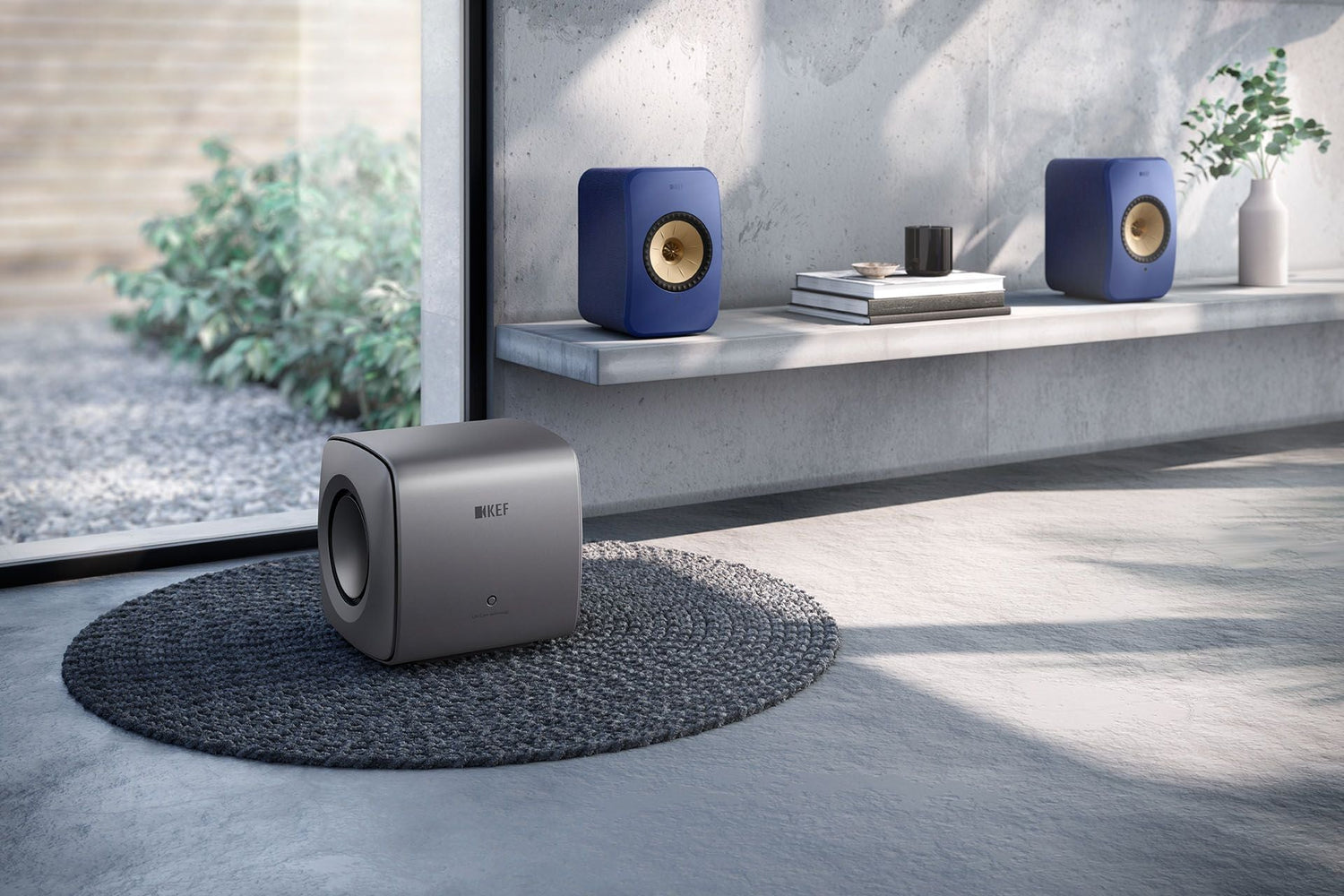
That’s why, for a complete package, enthusiasts opt for bookshelf speakers and a subwoofer. It’s the classic alternative to floorstanders. It blends flexibility, a reduced visual footprint, and full performance.

The thing is, as I mentioned before, floorstand speakers rarely provide full bass extension on their own.
Below I’ll provide some specs, but before I do, a quick note. The low-end number of a speaker’s “frequency response” spec describes where the bass response has rolled off to -3 dB or -6 dB. So if the spec says the low-end is 55 Hz, it really loses performance at a higher frequency than that.
Now it’s worth adding that a lot of the deep, rich bass we all love is happening above 40 Hz. Lower frequencies really transition from “hearing” into “feeling” below that point. That said, the 20–40 Hz range definitely adds realism and magnitude to the experience.
Okay, here are some floorstander low-end cutoff numbers:
- Acoustic Energy AE109.2 are rated at 41Hz (-3 dB)
- Acoustic Energy AE120.2 are rated at 39 Hz (-3 dB)
- KEF Q7 Meta are rated at 46 Hz (-6 dB; keep in mind this loses performance quite a bit higher)
- KEF R5 Meta are rated at 29 Hz (-6 dB; same again)
That’s just a few models to give you an idea. They extend well — much better than their bookshelf counterparts — but there’s some sub bass to be desired.
Does that mean floorstanders aren’t worth it? That bookshelf speakers and a subwoofer is the better choice?
Not necessarily. Budget and size constraints aside, floorstanders will outperform bookshelf speakers (from the same model series) at medium and high volumes across the entire frequency range.
One of the biggest reasons for this is they usually have more drivers to share the load. Each driver handles a tighter frequency band, making it easier to produce separation and detail at higher volumes.

If a floorstander has the same number of drivers as its bookshelf counterpart, the advantage is the cabinet volume, which improves bass. Of course, as noted, a subwoofer will usually fill out the extension anyway.
Emphasis on “usually,” because in truth, some floorstanders CAN provide a complete bass reponse…
But the system still needs a sub. That’s because…
Bass waves are hypersensitive to placement, and the ideal placement for the mains is almost never the best for bass performance.
This is because low-frequency sound waves have longer wavelengths in relative to our physical spaces. That’s why you can hear a lot of bass in one spot, and then move a metre or so and the bass can suddenly disappear.
Bass waves also radiate in all directions from their source. Then, as you increase in frequency to the mid and treble range, the dispersion narrows. This is why you should always place speakers so the tweeters are sitting at ear level: the high-frequency waves they produce have very narrow dispersion patterns. They essentially fire straight ahead.
So with bass waves wrapping around the speakers and spreading around the room, they then bounce off of walls more than other frequencies. These bouncing waves will fill the room, cancelling bass in some areas and amplifying it in others.

Now, the thing is…
A pair of floorstanding speakers are your mains. Your left and right speakers. In order to give you quality performance across the whole spectrum, they need to placed correctly.
This is especially true with soundstage. Placement is crucial when it comes to stereo image.
However, the ideal placement for these mains is almost never going to give you the best bass response.
Because remember, bass performance is sensitive to placement too.
So when you set up your system and sit in your listening position, there’s a very good chance the bass will be lacking compared to what it should be. (Again, we’re assuming the floorstanders can produce full extension to begin with.)
Add a subwoofer, and the problem becomes easy to solve. You can place the subwoofer for best bass response while the mains are sitting right where they need to be.
Special mention: There’s actually another time where a subwoofer can always improve a system…
And that’s when you have an AV receiver or an electronic filter.
With a filter, you can tell the amplifier to cut off the lowest bass frequencies going to the main speakers. This makes their job easier — as the woofers then handle fewer frequencies — so they can produce a more accurate sound.
Then you set the subwoofer to crossover at a higher frequency (whatever the filter cutoff is) so it picks up the load, does what it does well, and results in an improved sound from the overall system.
So that’s another, conditional reason that subwoofers are great.
As a final, more technical idea: Almost every system would benefit from having more than one subwoofer.
Remember how bass waves are sensitive to placement? When you get one subwoofer in the right spot, you end up with great bass performance… but only in the main sitting location.
Adding additional subwoofers can cancel and boost areas where bass performance is off, giving the system a better bass response no matter where someone is sitting.
It’s a definite perk. Whether or not it’s worth it is up to the listener!
And on that note, it’s now time to come clean:
Actually, there are two times where a system doesn’t really need a sub…
If the main speakers really do extend to the bottom of human hearing and their ideal placement happens to match the placement for bass performance… then your system doesn’t really need a sub.
That’s true. And the other time is even more important:
Your system doesn’t really need a subwoofer when it’s not in your budget and you’re happy with the sound you’ve got!
Ain’t nothing wrong with that.
Yes, a good subwoofer will pretty much always improve a system’s performance, and it’s an improvement that most people will love. But it’s possible for a system to be totally satisfying without it.
That said, given that you’re reading this, you might be interested in getting a subwoofer.
If you’re interested, it’s worth trying one to see if you like it. Better bass performance can seriously improve the listening experience. Visit your local hi-fi showroom and try one out; play some of your favorite, bass-rich songs with and without one, and see how it feels.
On that note, the next question may be:
What does a good subwoofer look like?
Cheap subwoofers aren’t really worth it, unless it’s just for movies. They tend to be boomy and have poor tonal quality.
It’s hard to know if something is “cheap” since both “cheapness” and listening enjoyment are subjective things. But as a decent rule, if you’re on a tight budget, focus on lower-end products from brands who also have expensive subwoofers in their catalogue. It suggests quality intent, engineering resources, and experience.
Bonus points if it’s a brand that only makes subwoofers, and they have expensive high-end models (like the JL Audio Gotham sub below). Those tend to be the best performing subwoofers.

Also keep in mind that good stereo gear will last you. So it’s better to save up for a few more months to get something you really want, instead of taking a concession today.
Now, budget aside…
A good subwoofer will have a stiff driver and plenty of power. These go hand in hand, because lots of power is required to move a big, stiff driver. Ask your hi-fi dealer if you can press on the driver to see how stiff it is. Good sub drivers are hard to move.
A subwoofer with a stiff driver and a powerful amp will be able to move the driver quickly and return it to neutral as quickly as the audio signal demands. That means the bass will be accurate, and not boomy.
The quality of the amp inside will determine tonal quality. However, if the subwoofer is from a reputable brand and it has a stiff driver, you can trust the amp will be good.
Below are a few examples of excellent subwoofers that will improve almost any audio system that doesn’t have one.
5 of the best home audio subwoofers:
1. KEF Kube 8

KEF are primarily a loudspeaker company but they’ve been producing active subwoofers for around 30 years. The Kube 8 is an excellent choice on a budget. It can extend well into sub-bass territory (rated to 34 Hz) and has solid tonal quality and grip up to medium volume levels.
Price: $1,000 AUD
2. JL Audio Dominion d108

JL Audio on the other hand are primarily in car audio, which has led them to develop extremely durable and efficient subwoofers with high output capacity. Space is a premium in car enclosures, and the JL Audio d108 showcases exceptional extension for its size (rated at 29 Hz). Great choice when budget and space are concerns, but performance is crucial.
Price: $1,495 AUD
3. KEF Kube 15
 Bigger drivers can move more air; this 15-inch subwoofer is the largest option from KEF’s Kube series. This unit provides a similar tonal performance to the Kube 8, but can extend lower and deliver better overall performance at loud volumes. This is ideal for dedicated music listening and home theatre rooms.
Price: $2,000 AUD
4. KEF KC62

This one is a different beast entirely. KEF leaned into their world-class R&D department to develop a subwoofer that offered amazing performance from an unbelievably small package. KC62 uses double 6.5-inch drivers, each with its own 500 W amplifier, to do it. It’s roughly the size of a football, but extends right down to 11 Hz while maintaining tonal quality and grip.
Price: $2,500 AUD
5. JL Audio E110

This is JL Audio’s more advanced series above the Dominion above. The 10-inch driver is extremely deep and provides an enormous excursion, allowing it to perform like a much bigger one. It also sports 1200 W of power and JL Audio’s exceptional grip. In this list, this subwoofer is the flagship choice for depth and performance at any volume level.
Price: $2,995 AUD


